By 11, your kid isn’t a beginner anymore. They understand the game. They know the rules, they know what’s happening on every pitch, and they’re stronger than they were even a year ago. So the bat conversation changes a little. It’s not just “what fits”; it’s “what gives them a small edge without slowing them down.
And I’ll tell you upfront where I land on this, same as always: technique beats equipment. I could hand a kid a $2,000 bat, or an illegal one, and if the technique isn’t there, it does nothing. The bat helps. It doesn’t hit for you. Keep that in the back of your mind while you shop.
Now let’s get the actual bat size for an 11-year-old, right?
The Short Answer: Bat Size for an 11-Year-Old
Most 11-year-olds do well with a 30-inch bat and a -10 drop, which comes out to around 20 ounces. That’s the standard bat size for an 11-year-old at an average size, right in the middle of the range.
But 11 is where the range really opens up, because kids this age are all over the map in size and strength. A late-developing 11-year-old and a big, strong one need different bats.
| Player Size | Bat Length | Drop Weight | Est. Bat Weight |
|---|---|---|---|
| Smaller / lighter | 29″ | -10 or -11 | 18–19 oz |
| Average | 30″ | -10 | 20 oz |
| Taller / stronger | 30–31″ | -8 to -10 | 22–23 oz |
Use the bat size calculator for a recommendation based on your child’s real height and weight.
What’s Different at Age 11
The jump from 10 to 11 is partly physical, but it’s also mental. At 11, a kid understands the game in a way they didn’t before. They read situations. They know why they’re doing what they’re doing at the plate. That maturity changes how they use a bat.
They’re also stronger. An 11-year-old is not going to swing the same bat they used at 9 or 10, they’ve outgrown it, usually in both length and weight. If your kid is still swinging last year’s bat, it’s probably time to move up.
And here’s where a lot of parents start thinking about getting an edge. Around this age you start asking yourself: this bat’s fine, but what if the barrel was a little better, the handle a little lighter, the weight sitting in a slightly different spot? That instinct isn’t wrong. Bats today are built differently than the cheap metal tubes from 20 years ago. The technology now lets manufacturers tune a bat to a player in ways that used to be impossible. Which is exactly why you don’t just order one online and hope for the best, you try it.
Balanced vs End-Loaded (The Thing Most Parents Don’t Know)
Here’s something that will make you smarter than most people at the sporting goods store.
Two bats can weigh the exact same 20 ounces and feel completely different in your hands. The difference is where the weight sits.
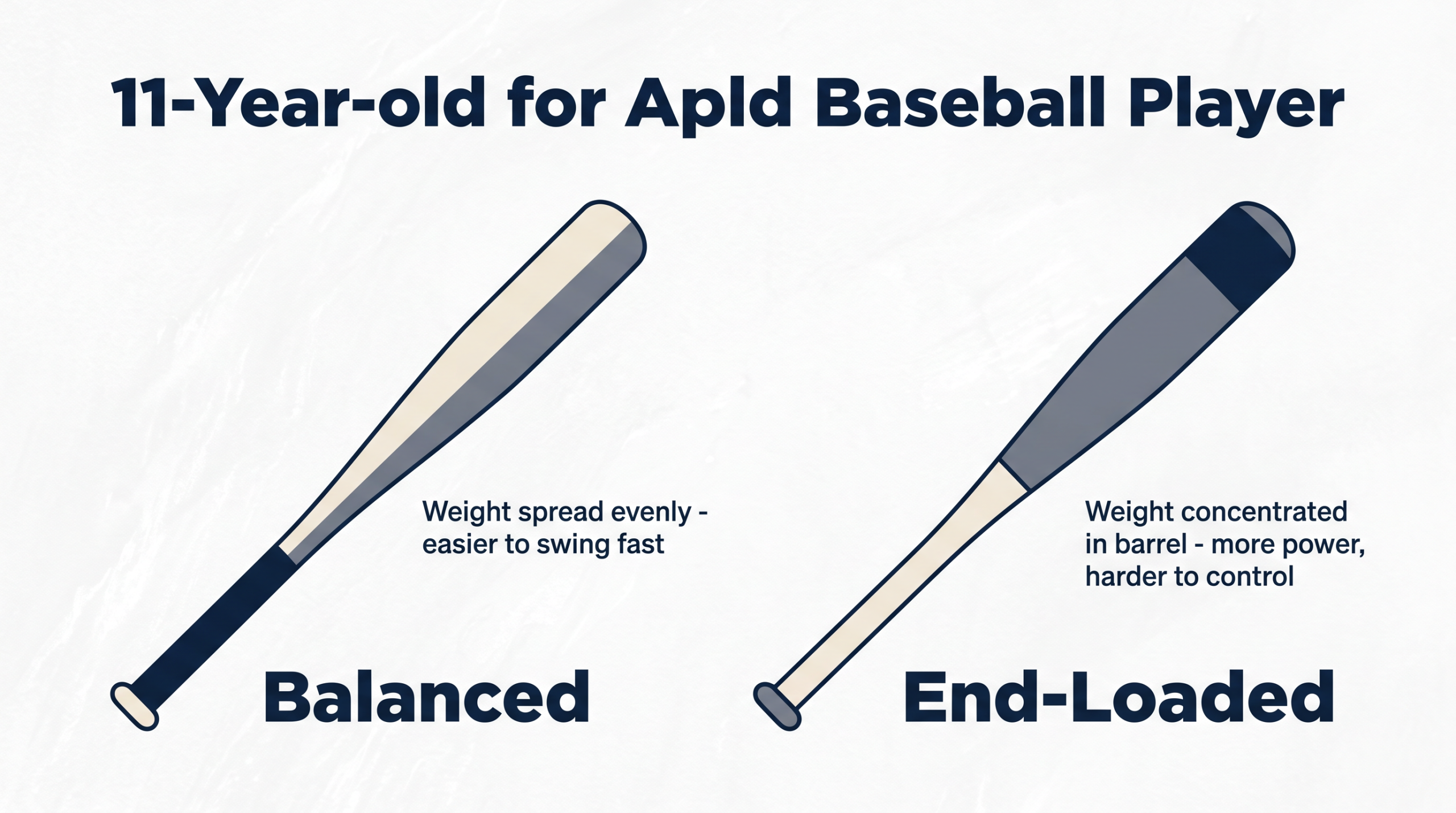
A balanced bat spreads the weight evenly from handle to barrel. It feels lighter than it actually is. It’s easier to control and easier to get through the zone fast. This is what most 11-year-olds should be swinging, and honestly it’s what I always preferred myself, I liked a thin barrel I could whip through the zone quickly. Fast bats win. I never went up there looking for home runs. I looked to make contact, because when you put the ball in play, good things happen. That’s true at 11, and it’s still true in the Major Leagues.
An end-loaded bat packs more of the weight out in the barrel. It feels heavier than it is, because weight at the end of the bat is harder to swing, same reason a hammer is harder to swing when you hold it by the head instead of the handle. That extra weight behind the ball adds power, but only if the kid is strong enough to still swing it fast. For a big, strong, advanced 11-year-old, end-loaded can work. For most kids this age, it’s too much bat and it slows them down.
The rule is simple: bat speed wins. If a bat is slowing your kid down, it’s the wrong bat, no matter how much extra “power” the barrel supposedly adds. When you pick up a bat, you don’t want to feel the barrel pulling heavy or feeling dead-light. You want it balanced, so the kid can get it through the zone quick. That’s the whole game.
For most 11-year-olds: go balanced.
What League Are They Playing In?
At 11, league rules matter more than ever, because some kids are still in USA Baseball divisions and others have moved into USSSA travel programs. These use different certification stamps and the bats are not interchangeable.
USA Baseball bats carry the USA Baseball stamp and are required in most rec and Little League divisions. USSSA bats carry the 1.15 BPF thumbprint and are used in many competitive travel programs. A USA bat is illegal in a USSSA game and vice versa.
Before you buy anything, ask the coach which stamp your league requires. The rules also vary by state and change year to year, so don’t assume last season’s answer still holds. An illegal bat can get a kid tossed from a game or worse.
→ Full comparison: USA vs USSSA bats
Try Before You Commit
I’d never tell someone to order a bat online and just hope it works out. Most retailers have good return policies now, so you have some protection, but that’s not the point. The point is that a bat has to feel right in the kid’s hands, and you can’t know that from a product photo.
If you can get to a batting cage that has demo bats, and I know they’re harder to find than they used to be, that’s the best thing you can do. Let your kid take 15 or 20 real swings with a couple of different bats. Watch how it looks. Is the swing smooth or is the kid fighting the bat? Is the barrel getting to the ball on time? A bat that fits makes a kid look like a hitter. A bat that doesn’t makes them look like they’re chopping wood.
How to Check the Fit
The Arm-Extension Test
Have your child hold the bat straight out to the side at shoulder height, arm fully extended, bat parallel to the ground. Steady for 20 to 30 seconds means the weight is right. Arm drops fast means it’s too heavy.
The Comfort Test
Watch the grip. Most kids squeeze too hard, and a heavy bat makes it worse. The grip should be relaxed. A loose, natural hold gives a better follow-through. White-knuckling the handle before the swing even starts means the bat is probably too heavy.
The Ground Test
Stand the bat on the ground next to your kid’s leg. The barrel should reach around mid-hip. Below the knee is too short. Above the belly button is likely too long.
Recommended Bat Size for an 11-Year-Old
Smaller or Lighter Players (under 75 lbs, under 4’9″)
29 inches, -10 or -11 drop (18–19 oz)
A smaller 11-year-old might still be in the same range as an average 10-year-old, and that’s completely fine. Control and bat speed matter more than length. Don’t push a bigger bat on a kid who isn’t ready for it, it’ll just wreck their swing.
Average Players (75–95 lbs, 4’10″–5’1″)
30 inches, -10 drop (20 oz)
The standard 11-year-old bat. Twenty ounces at 30 inches, balanced, is a bat most kids this size can control while still getting it through the zone quickly. This is the safe, smart default.
Taller or Stronger Players (95+ lbs, 5’2″ and above)
30–31 inches, -8 to -10 drop (22–23 oz)
A big, strong, advanced 11-year-old can handle more bat, a -8 drop or even a slight end-load if they’re genuinely strong enough to keep their bat speed up. But be honest about it. If a heavier bat slows the swing down at all, drop back to -10. Speed first, always.
Composite vs Alloy for an 11-Year-Old
Alloy bats are durable, ready to swing immediately, and usually cheaper. Great for rec players or anyone who doesn’t want to deal with a break-in period.
Composite bats need 150 to 200 hits to break in, have a bigger sweet spot when broken in, and hold up well for serious players. They cost more and can crack in cold weather (below about 60 degrees).
For a competitive 11-year-old on a travel team, a quality composite is a reasonable investment, it lasts longer and takes the wear and tear of a real season. For a rec player, alloy is perfectly fine and saves you money.
Frequently Asked Questions
My 11-year-old wants an end-loaded bat because a teammate has one. Should I get it?
Only if your kid is genuinely strong enough to swing it fast. An end-loaded bat in the hands of a kid who can’t handle it slows the swing down and hurts contact. What another kid uses doesn’t matter, their swing isn’t your kid’s swing. Test it and watch the bat speed before you decide.
Should an 11-year-old move to a -8 drop?
A bigger, stronger 11-year-old can, especially if they’re heading toward competitive travel ball where heavier drops are common. But there’s no rush. A -10 is fine at this age. Only move to -8 if the kid passes the arm-extension test easily and their swing stays fast.
How do I know if last year’s bat is too small now?
If the barrel only reaches the knee on the ground test, or the kid looks cramped swinging it, they’ve outgrown it. Kids grow fast at this age. It’s normal to move up an inch from 10 to 11.
Do I need to spend more on a bat at 11 than I did at 10?
Not necessarily. If your kid is competitive and putting in real time, a quality bat is worth it for durability and feel. But an expensive bat won’t fix technique. Spend on the right fit, not the biggest price tag.
Use the bat size calculator to get a recommendation based on your child’s age, height, weight, skill level, and league. And always confirm your league’s bat rules before buying, they change, and they vary by state.