Everyone thinks a lower drop number means more control. It doesn’t work like that.
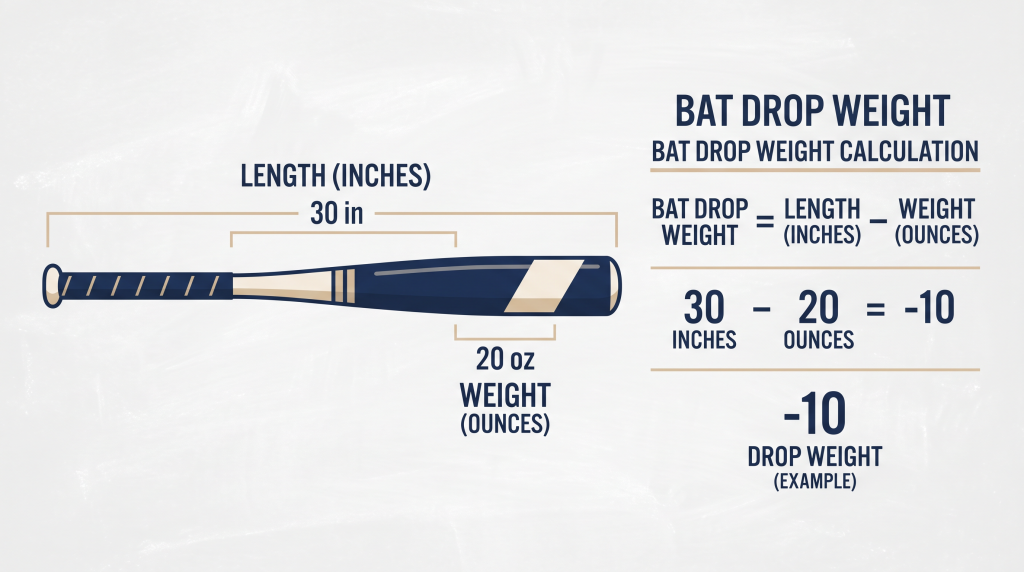
Bat drop is just subtraction. Take the bat’s length in inches, subtract the weight in ounces, and that’s your drop. A 30-inch bat that weighs 20 ounces has a drop of -10. That’s it. No mystery, no magic formula.
Here’s where parents get it wrong. They see a chart, see their kid’s age lines up with a -10, and they think switching to that number is going to suddenly fix the swing. Kid’s gonna start ripping the ball, more control, better bat speed, all of it.
It’s not that simple.
Control comes from strength. It comes from stance. It comes from how a kid actually moves the bat through the hitting zone, their mechanics, their timing. The drop number is one piece of that picture, not the whole thing. Two kids can swing the exact same bat, same length, same drop, and one has real control while the other doesn’t. The bat didn’t change. The kid did, or didn’t.
So yes, a lighter bat relative to its length is generally easier to handle for a kid who isn’t strong yet. That part’s true. But going by age alone and assuming a certain drop number will automatically produce better control skips over the kid standing in front of you. Strength, technique, and stance matter more than the number stamped on the barrel.
The Actual Math
Length minus weight. That’s the whole formula.
A 30-inch bat weighing 20 ounces: 30 minus 20 is 10, so that’s a -10 bat drop. A 28-inch bat weighing 18 ounces is also a -10. Same drop number, different bat, because it’s about the relationship between length and weight, not one or the other on its own.
Higher drop number, lighter bat relative to its length. -12 is lighter than -10. -10 is lighter than -8. Youth bats mostly run from -8 to -13. As kids get older and stronger, that number typically comes down, eventually landing at -3 once they’re swinging BBCOR in high school.
Typical Drop Ranges by Age (A Starting Point, Not a Guarantee)
There’s no guarantee in any of this. A minus-10 doesn’t promise anything. A minus-12 doesn’t promise anything either. These numbers give you a rough idea of where to start, not an exact outcome you’re going to see on the field.
| Age | Typical Drop Range |
|---|---|
| 7-8 | -12 to -13 |
| 9-10 | -10 to -12 |
| 11-12 | -8 to -10 |
| 13-14 (transition) | -5 to -8 |
| High school (BBCOR) | -3 |
Use this as a starting point, nothing more. What actually matters is whether your kid can control the bat through the strike zone, and that comes down to strength, stance, and what kind of hitter they are. A smaller kid who’s a contact hitter might do better a notch lighter than the chart says. A bigger, stronger kid with more of a power swing might handle a notch heavier just fine. The chart doesn’t know your kid. You do. “For the fuller picture across all these ranges, the baseball bat size chart breaks it down further.”
What Kind of Hitter Is Your Kid?
The bat drop number isn’t the only thing that should factor into bat length, either. What kind of hitter your kid actually is matters just as much.
A contact hitter wants a longer bat. More plate coverage, more chances to just get the bat on the ball and beat out the throw to first. Making contact is the whole goal, not driving it 300 feet.
A power hitter wants a bigger barrel. That’s where the pop comes from. A power hitter doesn’t want the ball catching the handle, that’s a broken bat or a weak dribbler, not a line drive.
Then there’s the spray hitter, spreading the ball around the field instead of pulling everything, and the all-or-nothing hitter, the one who strikes out a ton but also drives the ball when they connect. Different mentality entirely from how the game used to be coached, where the only instruction was “put the ball in play.” Kids get taught differently now, and some of that swing-for-it mentality actually fits certain hitters.
Here’s the hard part for parents. Every kid wants to be the home run hitter. That’s the dream. But you’ve got to be honest about what you’re actually looking at. If your kid makes contact consistently and doesn’t have much pop yet, coaching them toward a power swing and a bigger barrel isn’t doing them any favors. Match the bat, and the approach, to the hitter actually standing in the box, not the one you’re hoping shows up.
Frequently Asked Questions
What’s a good Bat drop for a beginner? Somewhere between -11 and -13, depending on age and size. A lighter bat is generally more forgiving for a kid still learning the swing, but it’s still a starting point, not a rule. Watch how they actually handle the bat, not just the number. If you want a starting-point recommendation based on their actual height and weight, the bat size calculator can give you a number to work from.”
Does a higher drop mean less power? Generally, yes, a lighter bat produces less raw power on contact than a heavier one, assuming the same swing. But a kid who can’t control a heavier bat isn’t going to hit it hard anyway. Control comes first. Power without contact is nothing.
Can a drop number be too high? Yes. Too light and a kid starts whipping the bat with no control, no idea where the barrel’s going. That’s not a better swing, that’s a worse one. There’s a floor as much as a ceiling.
When should my kid move to a lower drop? When the current bat starts feeling too easy, when they’re clearly stronger than the bat requires. Not automatically at a birthday. Some kids are ready a year early; some need an extra year at the lighter drop. Watch the kid, not the calendar.