For a lot of families, this is the big one. Twelve is usually the last year of youth baseball before high school and the switch to BBCOR bats, and that’s where parents tend to put their real money. I understand it completely. It’s the last youth bat, and there’s something that feels meaningful about that.
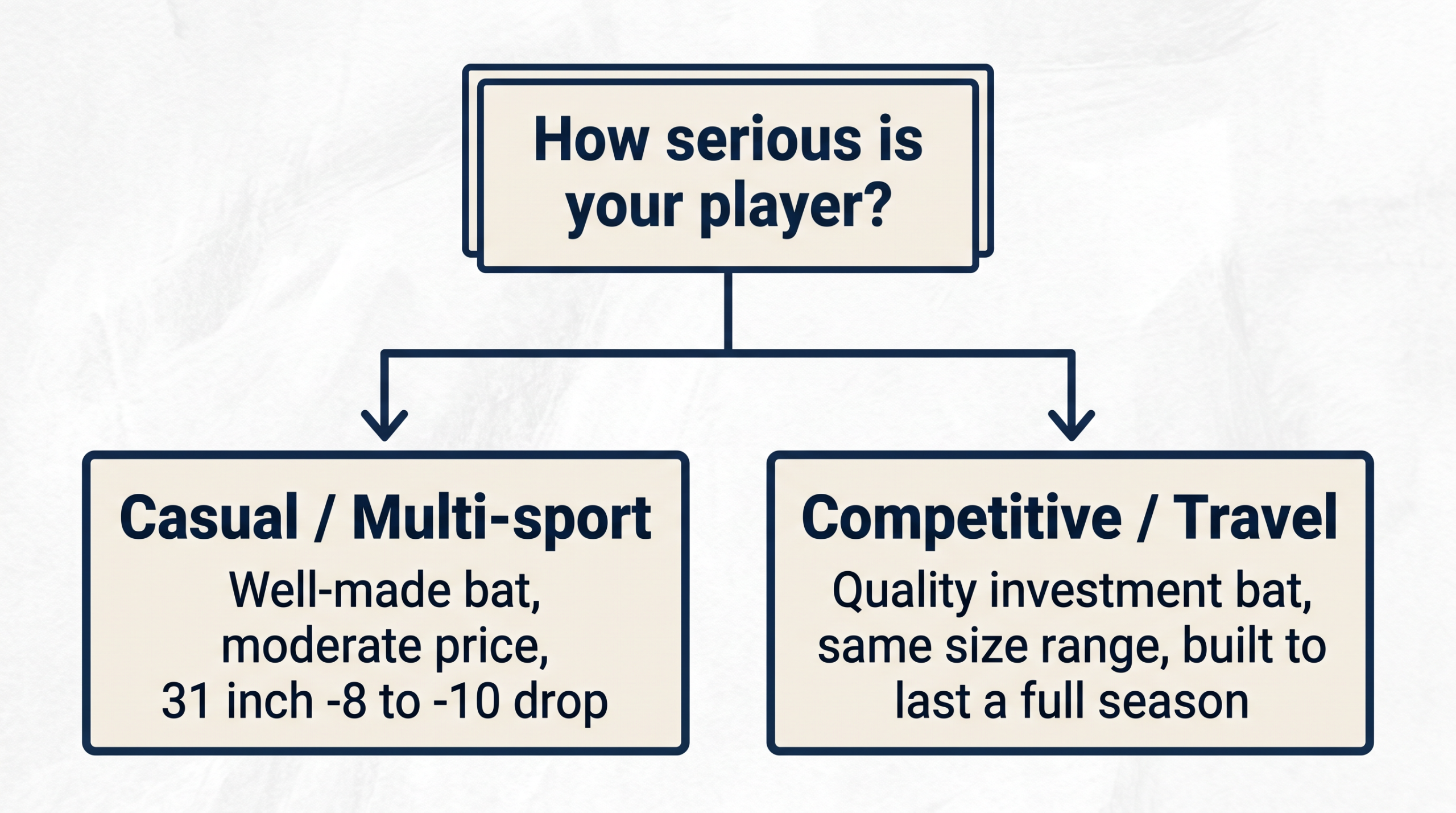
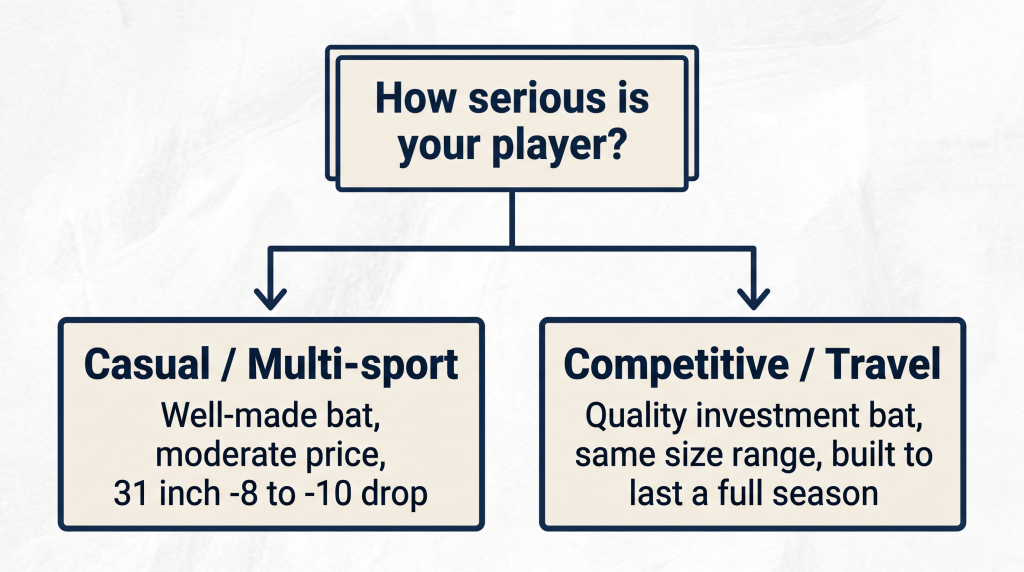
But before you spend $600, $700, $800 on a bat plus equipment, it’s worth asking an honest question: how serious is your child about this? Not how serious are you, how serious are they. Because a big investment makes sense for a kid who’s heading toward high school ball and putting in the hours at the cage. For a kid who plays a few sports and just enjoys baseball, a well-made bat that doesn’t cost a fortune is the smarter call. Both answers are fine. You just have to know which one you’re dealing with.
Now let’s get the actual bat size for a 12-year-old, right
The Short Answer: Bat Size for a 12-Year-Old
Most 12-year-olds do well with a 31-inch bat and a -8 to -10 drop, which puts the bat somewhere around 21 to 23 ounces depending on the drop.
Twelve-year-olds vary a lot in size and strength, so the range is wide:
| Player Size | Bat Length | Drop Weight | Est. Bat Weight |
|---|---|---|---|
| Smaller / lighter | 30″ | -10 | 20 oz |
| Average | 31″ | -8 to -10 | 21–23 oz |
| Taller / stronger | 31–32″ | -8 | 23–24 oz |
Use the bat size calculator for a recommendation based on your child’s real height and weight.
Know What Kind of Hitter Your Child Is
This is the part that matters most at 12, and it’s where a lot of families get it wrong.
By this age, your child has been playing long enough to know what kind of hitter they are. Are they a contact hitter? A power hitter? A kid who sprays the ball around the field? A leadoff type who gets on base and uses their speed? That answer should shape the bat.
A power hitter wants a bigger barrel. They’re looking to drive the ball, hit it hard, bring runners in. A larger barrel gives them more mass and a bigger sweet spot to do that.
A contact hitter or a leadoff type is a different story. They’re not trying to hit home runs, they’re trying to put the ball in play and use their speed. That kind of hitter is often better with a slightly longer bat for plate coverage and a balanced feel they can whip through the zone. Getting on base is the job, not launching it.
Here’s the honest part, and it’s important: be realistic about which one your child actually is. A lot of players, pushed by parents sometimes, try to be power hitters when they’re really contact hitters. They buy the big end-loaded bat, they start swinging for the fence, and their whole game falls apart. There’s nothing wrong with being a contact hitter. When you put the ball in play, good things happen. Know who your kid is and buy the bat for that hitter, not the hitter you wish they were.
It’s Mental as Much as Physical
Picking a bat at 12 isn’t just about height and weight anymore. It’s about your child coming to grips with the kind of player they are and being honest about it. This is the type of hitter I am, this is what I’ve been doing for years, this is what feels right in my hands.
And that comfort matters more than people think. A bat is like a glove, there’s a comfort level you develop with it that’s hard to explain until you’ve felt it. The right bat feels like an extension of your hands. When you’re shopping for that last youth bat, comfort should be near the top of the list, right alongside the sizing.
One more mental note, because I think it gets lost. Everyone treats high school like this huge, terrifying competition. But the only competition your child has to worry about is themselves. It doesn’t matter who else is on the team. If a kid focuses on what they do best and keeps refining it, everything else falls into place. The bat is a tool for that. It’s not the thing that gets them there, repetition is.
The BBCOR Transition Is Coming
The other thing on the horizon at 12 is BBCOR. High school baseball requires a BBCOR bat with a -3 drop, which is a lot heavier than the -8 or -10 your kid is swinging now.
Do not buy a BBCOR bat for a 12-year-old unless the league specifically requires it. There’s no advantage to jumping early, and the heavier bat will hurt their swing. Most kids make the BBCOR switch at 13 or 14 when they actually enter a high-school-level program. If your 12-year-old is in a program that’s starting to require heavier drops to prepare for that transition, that’s different, but confirm it; don’t assume it.
Worth knowing if you’re in travel ball: USSSA moved 14U to BBCOR -3 or wood on January 1, 2026. So a USSSA player faces two jumps, a -8 cap at 13U and then BBCOR at 14U. Here is what the 14U rule change means for what you buy now. For the high school side, see our breakdown of the 2028 bat rule change.
One small thing worth thinking about with that last youth bat: if your child really loves it, check whether the model is also made in a BBCOR version. Sometimes a bat gets discontinued at a specific level, and if your kid has a bat they love, having the same feel available when they move up can make the transition easier. It’s a small detail, but comfort carries over.
What League Are They Playing In?
At 12, some kids are still in USA Baseball divisions and others are deep into USSSA travel ball. The stamps are different and the bats are not interchangeable.
USA Baseball bats carry the USA Baseball stamp, required in most Little League and rec divisions. USSSA bats carry the 1.15 BPF thumbprint, used in most competitive travel programs. A bat legal in one is illegal in the other.
Check with the coach before you buy, especially at this age when a kid might be playing in two different programs. And remember the rules vary by state and change year to year. At 12, with the money you might be spending, an illegal bat is an expensive mistake.
→ Full comparison: USA vs USSSA bats
How to Check the Fit
The Arm-Extension Test
Have your child hold the bat straight out to the side at shoulder height, arm fully extended, bat parallel to the ground. Steady for 20 to 30 seconds means the weight works. Arm drops fast means it’s too heavy.
The Comfort Test
Watch the grip. A relaxed, natural hold produces a better swing. If your kid is squeezing the handle tight before the pitch even comes, the bat is probably too heavy. At 12, comfort is worth paying real attention to, this is a bat they’ll use all season.
The Ground Test
Stand the bat next to your child’s leg on the ground. The barrel should reach around mid-hip. Below the knee is too short. Above the belly button is likely too long.
Recommended Bat Sizes for 12-Year-Olds
Smaller or Lighter Players (under 85 lbs, under 5’0″)
30 inches, -10 drop (20 oz)
A smaller 12-year-old doesn’t need to force a bigger bat. Control and bat speed still win. A 30-inch, -10 bat they can swing freely beats a longer bat they have to muscle around every time.
Average Players (85–105 lbs, 5’1″–5’4″)
31 inches, -8 to -10 drop (21–23 oz)
The standard 12-year-old bat. The drop depends on strength and hitter type. A contact hitter is usually fine at -10. A stronger kid or a developing power hitter can move toward -8. When in doubt, stay lighter and keep the bat speed up.
Taller or Stronger Players (105+ lbs, 5’5″ and above)
31–32 inches, -8 drop (23–24 oz)
A big, strong 12-year-old can handle a 32-inch bat at -8, especially a power hitter who wants the bigger barrel. Just make sure the swing stays fast. If the heavier bat slows them down at all, drop back down. Bat speed beats bat size at every age.
Composite vs Alloy for a 12-Year-Old
Alloy bats are durable, ready to swing right away, and usually cheaper. A solid choice for rec players or anyone who wants low maintenance.
Composite bats need 150 to 200 hits to break in, have a bigger sweet spot once broken in, and hold up well over a long season. They cost more and can crack in cold weather.
For a serious 12-year-old heading toward high school ball, a quality composite is a reasonable last-youth-bat investment. For a kid who’s playing for fun alongside other sports, alloy is completely fine and easier on the wallet.
One Last Thing
Whatever you decide, remember what this bat actually is. It’s the last one before high school, before things get more serious, before your kid is playing for something. Right now they’re playing because it’s fun. That’s worth holding onto.
Get a bat that fits, that’s legal, that feels good in their hands, and let them enjoy this last stretch of youth ball. The turning of that chapter comes soon enough.
Frequently Asked Questions
Should my 12-year-old get a BBCOR bat to prepare for high school?
Not unless the league requires it. BBCOR bats are much heavier and will hurt a 12-year-old’s swing. Most players transition at 13 or 14. If your child’s program specifically requires a heavier drop to prepare for the switch, confirm that directly with the coach before buying.
My 12-year-old is a power hitter. Should I get an end-loaded bat with a big barrel?
If they’re genuinely a power hitter and strong enough to keep their bat speed up, a bigger barrel makes sense. But be honest about whether they’re actually a power hitter or a contact hitter who wants to be one. An end-loaded bat that slows the swing down does more harm than good.
Is it worth spending $600+ on a last youth bat?
It depends entirely on how serious your child is. For a kid heading toward high school ball and putting in real time, a premium bat is a reasonable investment. For a kid who plays a few sports and enjoys baseball casually, spend less and put the difference toward reps and instruction.
Can a 12-year-old use a 32-inch bat?
A taller, stronger 12-year-old can. An average or smaller one usually can’t control it well. Do the arm-extension test and watch the swing. If the bat slows them down, it’s too much.
Use the bat size calculator to get a recommendation based on your child’s age, height, weight, skill level, and league. And always confirm your league’s bat rules before buying, they change, and they vary by state.