Ten is where things start to split. You’ve got kids playing recreationally once a week for fun, and you’ve got kids on travel teams who are practicing seriously, competing hard, and maybe dreaming about the Little League World Series. Those are two very different situations, and the bat decision looks different depending on which one you’re in.
Here’s the actual bat size for a 10-year-old, and why that rec-versus-travel split changes what you should buy.
The Short Answer: Bat Size for a 10-Year-Old
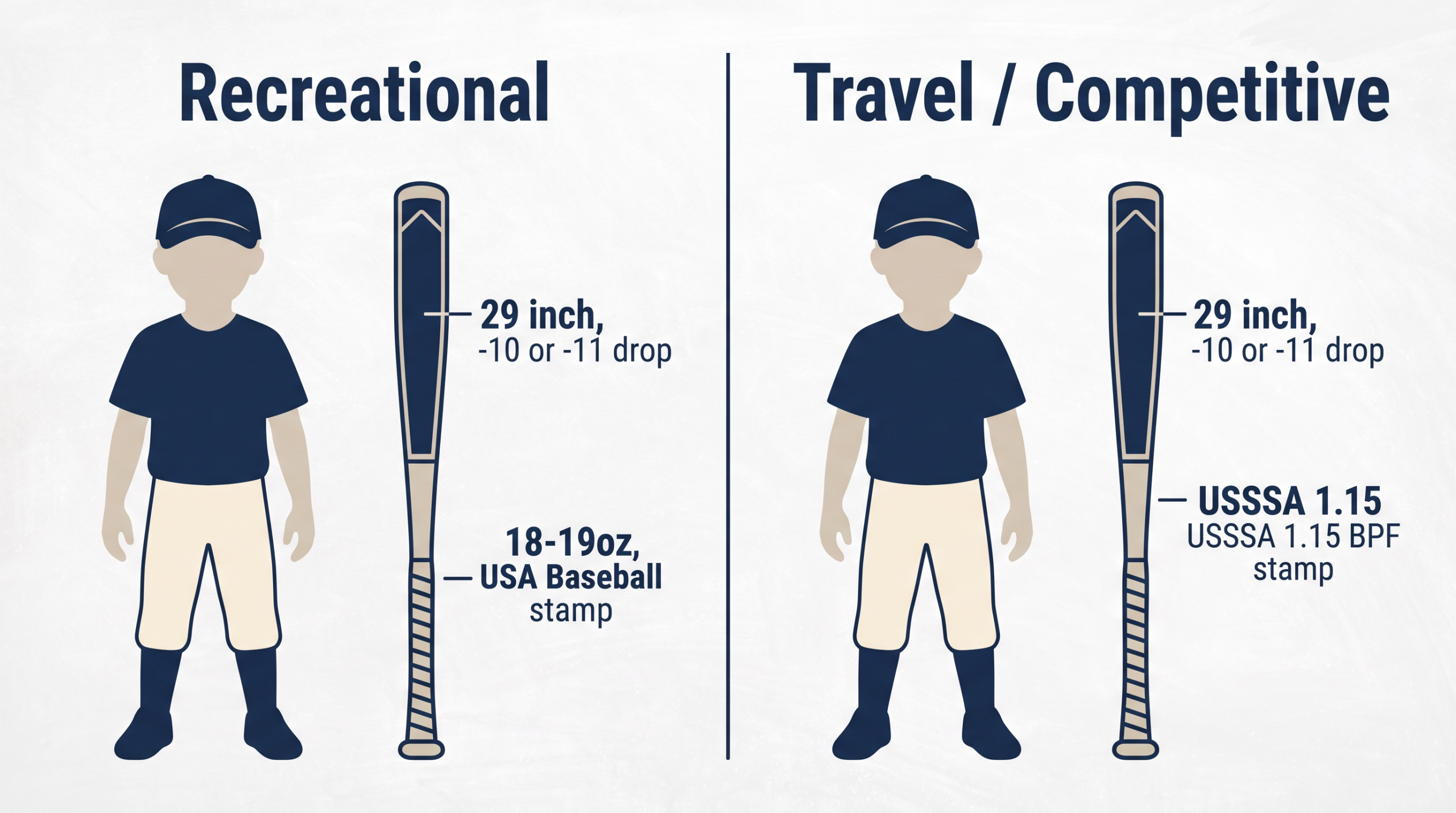
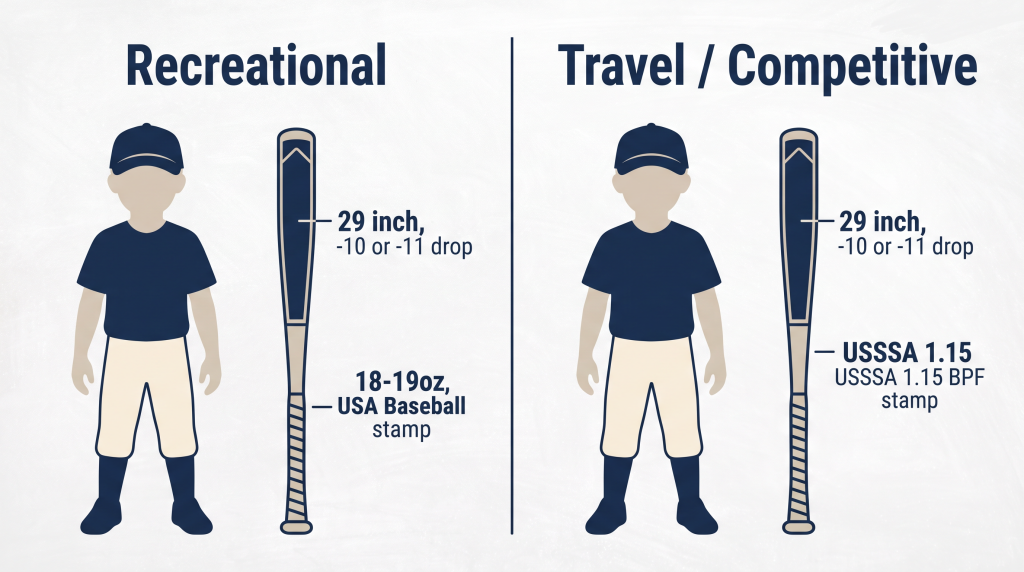
Most 10-year-olds do well with a 29-inch bat and a -10 or -11 drop, which puts the bat around 18 to 19 ounces. That’s the standard bat size for a 10-year-old at an average size.
But like I said, 10-year-olds are all over the place, in size and in how serious they are. Here’s the range:
| Player Size | Bat Length | Drop Weight | Est. Bat Weight |
|---|---|---|---|
| Smaller / lighter | 28″ | -11 | 17 oz |
| Average | 29″ | -10 or -11 | 18–19 oz |
| Taller / stronger | 30″ | -10 | 20 oz |
Use the bat size calculator for a recommendation based on your child’s actual height and weight.
What Changes at Age 10
A 10-year-old is a different player than a 9-year-old, and not just because of one birthday. A few things shift:
They’re bigger and stronger. The growth between 9 and 10 is real. A kid who needed a 28-inch bat last year might be ready for 29 or even 30 now. Don’t assume last year’s bat still fits.
The level of play separates. Some 10-year-olds are playing rec ball for fun, maybe with a dad who’s pushing a little harder than the kid wants. Others are getting to the point where this isn’t just recreational anymore. It’s becoming a real pursuit. The Little League World Series age range is right around here, and for some kids, that dream is very much alive.
The rules change. The rules shift almost every year at this level. Base-running rules, what’s allowed, what isn’t. And bat rules change too, from league to league and even state to state. What’s legal in one place isn’t legal in another.
There’s more physicality. The game gets faster and more competitive. The bat matters more than it did at 8 or 9, because the margins get tighter.
Recreational vs Competitive, Two Different Decisions
This is the fork in the road at age 10.
If your child is playing for fun
You don’t need to spend a lot. A solid bat in the right size for 50 or 60 dollars does the job. You can even find good used bats online. There’s no reason to drop hundreds of dollars on a bat for a kid who plays once a week and is in it to have a good time. Get the right size, make sure it’s legal for the league, and you’re done.
If your child is competitive or on a travel team
Now it’s worth spending more. And here’s the actual reason, it’s not about hitting more home runs. A higher-quality bat lasts longer and holds up to the abuse a travel-ball season puts on it.
Think about what a travel bat goes through. It’s in a bag on a bus. Kids bang it around. It gets normal wear and tear that a cheaper bat won’t survive. A better-made bat has a better grip, holds up longer, and doesn’t wear out the way a budget bat does. If your child is serious and putting in the time, that investment makes sense.
But, and this matters, even on a travel team, it’s still not always about the most expensive bat. It’s about a quality bat that fits your child and that they can control. Don’t buy the priciest one on the wall just because it’s the priciest. Look at what’s actually out there, not just what everyone else on the team is using.
The Illegal Bat Warning
This is the part you cannot skip if your child is competitive.
Some bats are not legal in certain leagues. If your child shows up with an illegal bat, it’s not just an inconvenience. They can be disqualified. There are real consequences.
The rules vary from state to state and league to league, and they change year to year. So before you buy anything for a competitive 10-year-old, you have to check. Confirm the certification stamp your league requires, USA Baseball or USSSA, and make sure the specific bat is on the approved list.
Most 10-year-olds are in USA Baseball leagues, which need the USA Baseball stamp. Some are in USSSA travel programs, which need the USSSA 1.15 BPF thumbprint. These are not interchangeable. One question to the coach saves you from an expensive, embarrassing mistake.
→ Full comparison: USA vs USSSA bats
You can also use the bat size calculator and check if your bat is legal right here on this site.
What Actually Matters When Picking the Bat
Same as it was at 9, and same as it’ll be at 12: height, weight, and athletic ability. Those three things determine the right bat far more than age alone.
A 10-year-old who’s small and still developing needs a bat they can control and get through the zone quickly. A 10-year-old who’s big and strong can handle more length and a little more weight. But in both cases, the goal is the same, a bat they can swing freely, control through the strike zone, and feel comfortable holding.
Bat speed beats barrel size. A kid who whips a 29-inch bat through the zone will out-hit a kid dragging a 30-inch bat through slowly. Comfort and control first. Everything else second.
How to Check the Fit
The Arm-Extension Test
Have your child hold the bat straight out to the side at shoulder height, arm fully extended, bat parallel to the ground. If they hold it steady for 20 to 30 seconds, the weight is right. If the arm drops fast, it’s too heavy.
The Comfort Test
Watch the grip. Most kids grip too tight, and a heavy bat makes it worse. The grip should be relaxed and natural. A loose grip gives a better follow-through. If your child is squeezing the handle white-knuckle tight before the swing even starts, the bat is likely too heavy.
The Ground Test
Stand the bat next to your child’s leg on the ground. The barrel should reach around mid-hip. Below the knee is too short. Above the belly button is probably too long.
Recommended Bat Sizes for 10-Year-Olds
Smaller or Lighter Players (under 65 lbs, under 4’6″)
28 inches, -11 drop (17 oz)
A smaller 10-year-old is often still in the same range they were at 9, and that’s fine. Control matters more than length. A 28-inch bat they can swing freely beats a 30-inch bat they have to muscle.
Average Players (65–85 lbs, 4’7″–4’9″)
29 inches, -10 or -11 drop (18–19 oz)
The standard 10-year-old bat. Between -10 and -11 depends on strength. If your child passes the arm-extension test easily, -10 is fine. If it’s borderline, go -11. When in doubt, lighter.
Taller or Stronger Players (85+ lbs, 4’10” and above)
30 inches, -10 drop (20 oz)
A bigger, stronger 10-year-old can handle 30 inches. This is often the size a competitive travel-ball kid lands on. Just make sure the athletic ability actually matches the size, don’t buy up hoping they grow into it mid-season.
Composite vs Alloy for a 10-Year-Old
At 10, this question matters more than it did at 9, especially for competitive players.
Alloy bats are durable, ready to use immediately, and usually cheaper. Good for rec players and anyone who doesn’t want to deal with a break-in period.
Composite bats need 150 to 200 hits to break in, but tend to have a better feel and hold up well for serious players. They cost more and shouldn’t be used in cold weather, where they can crack.
For a competitive 10-year-old putting in real time, a quality composite bat is a reasonable investment. For a rec player, alloy is perfectly fine and saves you money.
Frequently Asked Questions
My 10-year-old made a travel team. Do I need to spend $300+ on a bat?
You don’t have to, but it’s more justifiable now than it was in rec ball. The value in a better bat is durability and grip quality, not magic performance. A travel season is hard on equipment. A quality bat holds up. Just don’t confuse “expensive” with “better for my kid”, fit and control still come first.
Can a 10-year-old swing a 30-inch bat?
A bigger, stronger 10-year-old, yes. An average or smaller one, probably not comfortably. Do the arm-extension test before you decide. If the arm drops, the bat is too much regardless of what the chart says.
How do I know if a bat is legal for my league?
Check the certification stamp, USA Baseball or USSSA, and confirm the specific bat is approved by your league. Rules vary by state and change year to year. Ask your coach directly. An illegal bat can get a player disqualified.
Should I size up so the bat lasts more than one season?
No. Buy the size that fits now. A 10-year-old grows, and a bat that’s too big this year to “save money later” just hurts their swing this year. Resize when they actually need it.
Use the bat size calculator to get a recommendation based on your child’s age, height, weight, skill level, and league. And always confirm your league’s bat rules before buying, they change, and they vary by location.