I built the free bat sizing calculator and legality checker on this site. This page exists because I could not get a straight answer about which stamp my league wanted, and the guy at the sporting goods store was guessing.
Here is the short version, and it is the only sentence that matters if you read nothing else.
Your league picks the certification. You do not get to choose. A $350 bat with the wrong stamp is a $350 bat your kid cannot use.
There are four bat certifications in youth and amateur baseball, each with its own stamp. Below is which one goes where, what the mark looks like, and the two rule changes that are moving underneath it right now.
Check Your Bat Certifications First
Before reading anything else, run your bat through the checker. Pick your league and division and it tells you which certification you need.
If the answer surprised you, keep reading. If it did not, you are done and you can go buy the bat.
Is your bat legal?
Answer two quick questions and see which certification your player’s league requires, plus the 2026 rule change that made a lot of bats illegal at 14U. Free, no email.
BatBlueprint is an independent guide, not a governing body. Certification rules are set by your league, and tournaments can add their own. Always confirm with your coach or director before you buy or play. Rules current as of the 2026 season.
The four stamps
USABat
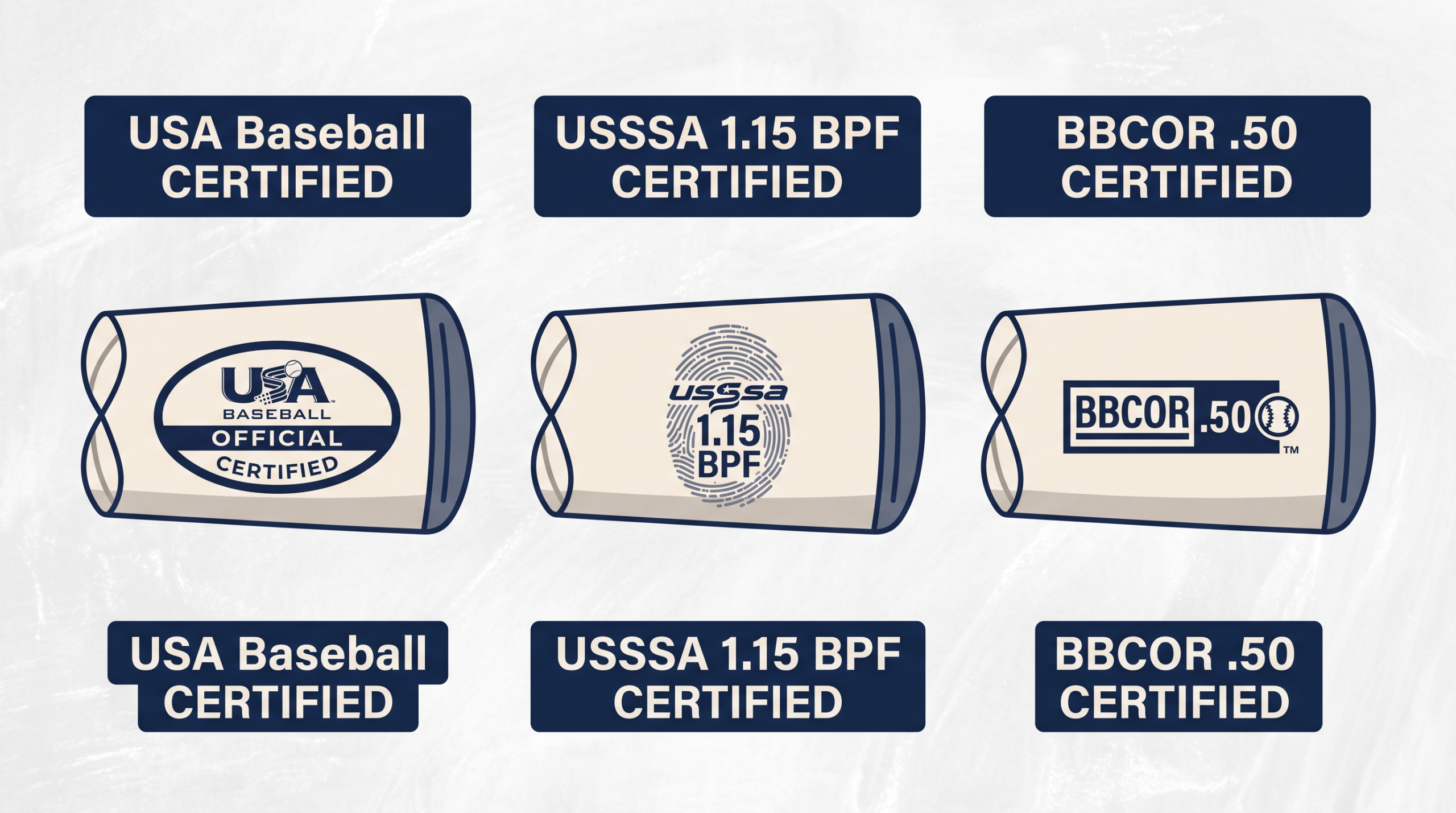
The USA Baseball mark. Wood-like performance standard, introduced in 2018.
Required by most rec leagues: Little League, Cal Ripken, Babe Ruth, PONY, Dixie Youth, and AABC. If your kid plays in a league that has a board and a snack stand, it is probably a USA Baseball league.
Look for a permanent USA Baseball mark on the barrel. Tee ball bats are separate and carry wording about approved tee balls specifically, so a tee ball bat is not a youth bat with a smaller barrel.
USABat allows any drop weight. That is the point of it. A 10 year old can swing a -11 and a 13 year old can swing a -5 under the same certification.
USSSA 1.15 BPF
The thumbprint mark, usually on the taper rather than the barrel.
BPF stands for Bat Performance Factor. The 1.15 standard allows more performance than USABat, which is why travel programs use it and why a USSSA bat feels hotter off the barrel.
Used by independent travel and select programs. If your kid plays weekend tournaments against teams from three counties over, that is usually USSSA.
USSSA sets drop weight limits by age on top of the stamp. At 13U the cap is a drop 8. And 14U changed completely this year, which gets its own section below because it is catching families off guard.
BBCOR .50
Required in high school baseball under NFHS rules and in NCAA college baseball.
BBCOR is not just a performance standard. It comes with hard physical limits: drop 3 maximum, barrel no wider than 2 5/8 inches, length no more than 36 inches. Every BBCOR bat is a drop 3. A 33 inch BBCOR bat weighs 30 ounces, always.
The mark reads BBCOR Certified .50 and it has to be permanent.
USA BBCOR
The newest one, and you will not see it on a shelf until July 1, 2027.
USA Baseball took over management of the BBCOR standard from the NCAA on July 2, 2026. Same test, same performance limit, new name and new organization running it. Bats will carry a mark reading USA Baseball BBCOR Certified .50.
Nothing about it makes bats hotter. It is an administrative change with a new label.
Which certification by league
| League or program | Certification required |
|---|---|
| Little League (Majors and below) | USABat |
| Little League Intermediate and Junior | USABat or BBCOR |
| Little League Senior | BBCOR |
| Cal Ripken / Babe Ruth | USABat |
| PONY, Dixie Youth, AABC | USABat |
| USSSA travel, 13U and under | USSSA 1.15 BPF, drop limits by age |
| USSSA travel, 14U national events | BBCOR or wood |
| High school (NFHS) | BBCOR, plus USA BBCOR and USABat -4, -5, -6 starting 2028 |
| NCAA college | BBCOR now, USA BBCOR only from January 1, 2029 |
Two things this table cannot tell you.
Local rules override national ones all the time. A tournament director can require wood. A state association can carve out an exception. The stamp gets you in the door, the event rules decide the rest.
And divisions matter more than age. Little League does not think in terms of 12U or 14U, it thinks in Majors, Intermediate, Junior, Senior. A 13 year old could be in two different divisions with two different bat rules depending on the program.
The 14U change that is catching people right now
This is the one costing families the most money in 2026.
Effective January 1, 2026, USSSA moved 14U from a maximum drop 5 to BBCOR drop 3 or wood as the national standard. All national USSSA 14U events now require BBCOR or wood. Some state level events still allow a -5 in limited local play, but the default nationwide is BBCOR.
What that means in practice: a USSSA bat that was legal for a player at 13U is not legal for that same player at a 14U national event. The bat did not change. The rule did.
If your player is 13U right now, plan the BBCOR purchase before next season instead of buying a USSSA bat with six months of life left in it.
The one piece of good news is that a BBCOR bat bought for 14U is the same bat they will need in high school. It is not a throwaway purchase.
How to read the mark on a bat
Takes about five seconds once you know where to look.
USABat: permanent USA Baseball mark on the barrel.
USSSA: thumbprint mark reading BPF 1.15, usually on the taper, which is the narrow part between the barrel and the handle.
BBCOR: permanent mark on the barrel reading BBCOR Certified .50.
USA BBCOR: permanent mark reading USA Baseball BBCOR Certified .50.
The word doing the work in every one of those is permanent. Stickers and decals are not accepted on any non-wood bat, in any league, ever. If the mark peels, the bat is not legal. That has been true for years and it is the single most common reason a bat gets pulled.
No mark at all means no. Doesn’t matter what the brand is, what it cost, or what the box said.
What happens if you bring the wrong bat
Most of the time an umpire or a coach spots it in warmups, the kid borrows a bat, and nothing else happens. Embarrassing, not fatal.
If it gets to the plate, Little League has an actual written penalty for it. Rule 6.06(d): the batter is out if they enter the box with an illegal bat, or if it’s discovered they used one before the next batter steps in. The ball is dead and runners go back to where they were.
The defense can decline the penalty and take the play instead, if the result was better for them.
Then it escalates. First violation, the offensive team loses one adult base coach for the rest of the game. Second violation, the manager gets ejected. Either way, the bat comes out of the game the moment it’s found.
Tournament play is harsher. Under the 2026 tournament rules, the manager is ejected, the batter who used the bat is ejected, and the team still loses a base coach.
One more that catches people. If the certification mark on a bat is no longer legible, that bat cannot be used and has to be removed. A worn off stamp is treated the same as no stamp. This is why a beat up hand-me-down can fail even when it was a legal model.
Other organizations write their own penalties, and they vary. The pattern is the same everywhere though: the bat leaves the game, and it usually costs you more than the at bat.
Decertified bats, the thing almost nobody covers
A bat that was legal when you bought it can stop being legal.
USA Baseball maintains a decertified bat list. When a model is found to perform above the standard after release, it comes off the approved list and stops being legal for play. It does not matter that you bought it in good faith from a real store.
The Easton Ghost X in 30/20 is one that got pulled. There have been others.
Two things worth doing about it. Check the decertified list before you buy anything used, since that is where decertified bats end up. And if you already own an expensive bat, check it once a season rather than assuming.
Age by age, roughly
This is a general map, not a rulebook. Your league is the rulebook.
| Age | Rec league | Travel |
|---|---|---|
| 4 to 6 (tee ball) | USABat tee ball | USABat tee ball |
| 7 to 12 | USABat, any drop | USSSA 1.15 BPF |
| 13 | USABat | USSSA, drop 8 maximum |
| 14 | USABat or BBCOR by division | BBCOR or wood at national events |
| High school | BBCOR | BBCOR |
League age is not the same as your kid’s age
This trips up more parents than any other part of it.
Bat rules follow the division. The division follows league age. And league age is not how old your kid is today.
Little League sets league age by a cutoff of August 31. A player born in September 2013 is league age 12 for the entire 2026 season. A player born in August 2013, three weeks earlier, is league age 13.
Those two kids can end up in different divisions with different bat rules while being nearly the same age. One might need a USABat, the other might have BBCOR as an option.
Check the official age chart before you assume which division your player lands in. Match the month to their birth year and it gives you their league age.
Travel organizations use their own cutoffs, which usually do not match Little League’s. If your kid plays both, you can have two different playing ages in one summer.
What is changing next
Two things on the calendar, and neither one makes your current bat illegal.
July 1, 2027: USA BBCOR bats arrive at retail. They are not legal for play until the 2028 season, so there is a six month window where you can buy one and not use it.
2028 season: high school baseball starts allowing USABat -4, -5 and -6 bats alongside BBCOR. That is the first time high school players have had a choice about drop weight since 2012. Full breakdown of the 2028 high school rule change here.
January 1, 2029: NCAA play requires USA BBCOR. Old BBCOR bats stop being eligible for college, though they stay legal in high school indefinitely.
If your kid is in Little League, none of this touches you yet. Little League said in July 2026 that the USA BBCOR change has no impact on the 2026 Intermediate, Junior, or Senior tournaments and will not affect the 2027 seasons either. They have said they will communicate any changes to the teenage divisions as the transition goes on.
Common questions
Can my kid use a USA Baseball bat in a USSSA tournament?
Usually yes, though it will feel dead compared to what everyone else is swinging, since USABat is a wood-like standard and USSSA allows more. Confirm with your event before you count on it.
Can my kid use a USSSA bat in Little League?
No. Little League requires USABat. This is the most expensive mistake in youth baseball and it happens constantly, usually when a bat gets handed down from a travel family.
Is a more expensive bat automatically legal?
No. Price has nothing to do with certification. Some of the priciest bats made are illegal in most youth leagues because they are built to a different standard.
My bat has a sticker with the certification on it. Is that okay?
No. The mark has to be permanent. Stickers and decals are not accepted on non-wood bats.
Do I need to buy a new bat because of the USA BBCOR change?
Not for high school. Existing BBCOR bats stay legal there with no cutoff date. For college, the deadline is January 1, 2029.
What about softball?
Different system entirely, with its own certifications. This page covers baseball.
Where does this information come from?
USA Baseball’s official USA BBCOR page, its decertified bat list, Little League’s bat information page, and Little League’s bat rules. Rules move. Confirm with your league before you spend money.
Know the certification but not the size? Run the bat sizing calculator.
Choosing between the two youth standards? USA vs USSSA compared head to head.