Let me be straight with you before we get into the numbers. The bat does not make the player. Technique does. Repetition does. Hand-eye coordination does. The bat is a tool, same as anything else, and buying the most expensive one on the wall is not going to fix a swing that needs work.
Now here’s the actual bat size for a 9-year-old, and how to get it right.
The Short Answer: Bat Size for a 9-Year-Old
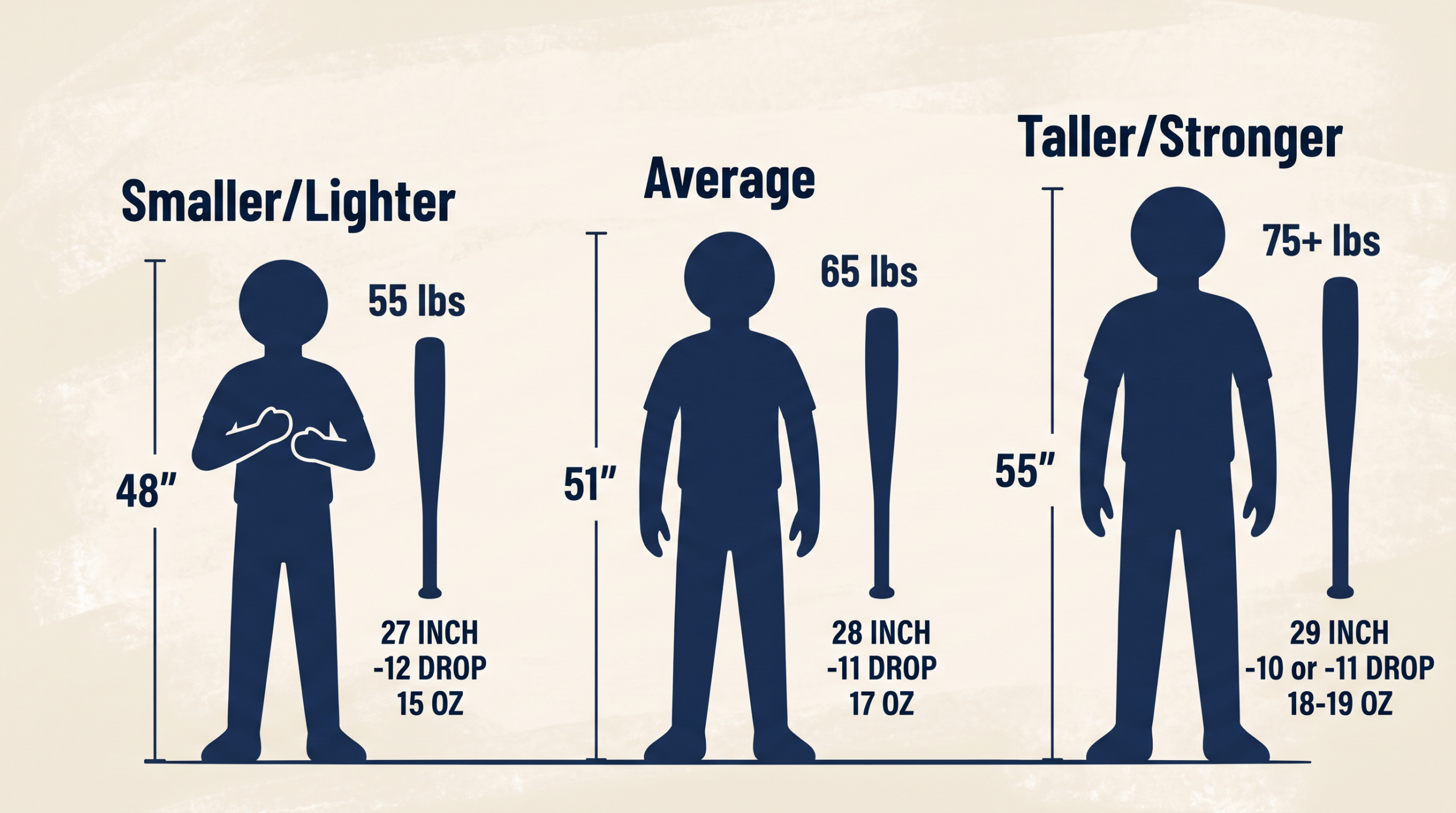
Most 9-year-olds do well with a 28-inch bat and a -11 drop, which puts the bat at around 17 ounces. That’s the middle of the range for this age, not too light, not too heavy, and manageable for an average-sized kid who’s still developing their swing.
But “most 9-year-olds” covers a lot of ground. A small, lighter kid and a big, strong kid who are both nine years old are in completely different situations. The table below breaks it down.
| Player Size | Bat Length | Drop Weight | Est. Bat Weight |
|---|---|---|---|
| Smaller / lighter | 27″ | -12 | 15 oz |
| Average | 28″ | -11 | 17 oz |
| Taller / stronger | 29″ | -10 or -11 | 18–19 oz |
Use the bat size calculator if you want a recommendation based on your child’s actual height and weight. It takes about 30 seconds.
The First Questions to Ask
When a parent asks me what bat their 9-year-old needs, the bat size is not the first thing I think about. The first things I ask are:
How physically strong are they? Not how old, how strong. A nine-year-old who’s been playing for two or three years and has real strength in their hands and wrists can handle more bat than a nine-year-old who just started.
What’s their stance and comfort level at the plate? A kid who’s uncomfortable before the pitch even comes isn’t going to get better by adding bat weight.
What league are they playing in? This matters a lot and a lot of parents skip it. A rec league nine-year-old playing for fun is in a completely different situation than a kid in a competitive travel program. The league determines which certification stamp the bat needs, and that changes your options.
Are they playing this for fun, or are they more advanced? There’s no wrong answer. But the answer changes what bat makes sense.
What League Are They Playing In?
This is the question that can cost you a lot of money if you ignore it.
Most 9-year-olds play in USA Baseball leagues, which require a bat with the official USA Baseball stamp on the taper. If you buy a bat without that stamp, it cannot be used in a USA Baseball game. Doesn’t matter how much it costs.
Some 9-year-olds are in USSSA travel programs, which require a different stamp, the USSSA 1.15 BPF thumbprint. These bats are not interchangeable with USA bats.
Before you buy anything, ask the coach which stamp is required. One question saves you from an expensive mistake.
→ Full comparison: USA vs USSSA bats
Small Kid vs Big Kid, How to Think About It
I was a smaller kid growing up. Very small, very skinny. And I can tell you from experience, a bat that’s too big does more damage than good. You can’t control it. And when you can’t control it, you start doing things with your swing to compensate. You grip tighter. You wave at the ball instead of driving through it. You develop habits that are hard to undo.
The biggest thing for a smaller 9-year-old is control. A 27-inch bat at -12 drop, 15 ounces, sounds almost too light, but if your child can swing it freely and get it through the zone quickly, they’re going to make more contact than they would with a bigger bat they’re muscling around.
For a bigger, stronger kid, there’s a tendency for parents to go for the large barrel and the extra length thinking it’ll produce more power. And yes, a bigger barrel gives a larger sweet spot. But here’s what actually matters more: getting the bat through the zone faster. A kid who can get a 28-inch bat through the zone quickly is going to hit the ball harder than a kid dragging a 30-inch bat through at half the speed. Bat speed matters more than barrel size at this age.
What it really comes down to, for small kids and big kids both, is what feels comfortable. Not what looks impressive. Not what the kid next to them is using. What your child can grip naturally, swing freely, and control through the strike zone.
The Mistake Most Parents Make
They buy the most expensive bat.
I understand why. You want the best for your kid. That’s a good instinct. But at nine years old, a $400 bat is not the investment people think it is.
Here’s what actually happens. The kid gets the bat. They practice once a week. The bat sits in a bag the rest of the time. A few months in there are dings in it, sometimes worse. Kids at this age don’t place the same value on a $400 piece of equipment that you do, and that’s completely normal. They’re nine.
What actually moves the needle at this age is repetition. Hitting off a tee in the backyard. Taking cuts consistently. Developing hand-eye coordination. Working on the swing. None of that requires an expensive bat. A solid bat in the right size range, approved for the league, that your child feels comfortable holding, that’s the investment that matters.
How to Tell If a Bat Is the Right Size
The Arm-Extension Test
Have your child grip the bat handle and hold it straight out to the side at shoulder height, arm fully extended, bat parallel to the ground.
- Holds it steady for 20 to 30 seconds without the arm dropping → weight is right
- Arm drops immediately → bat is too heavy
- Holds it easily for a full minute → might be able to go slightly heavier
The Comfort Test
Watch how your child grips the bat. About 90% of kids grip way too tight, and a bat that feels heavy makes that worse. The grip should be relaxed, more like holding it than squeezing it. A loose, natural grip produces a better follow-through. If your child is white-knuckling it from the start, the bat is probably too heavy.
The Ground Test
Stand the bat on the ground next to your child’s leg. The barrel should reach somewhere around mid-hip. Below the knee is too short. Above the belly button is likely too long.
Recommended Bat Size for a 9-Year-Old
Smaller or Lighter Players (under 55 lbs, under 4’3″)
27 inches, -12 drop (15 oz)
Control is everything at this size. A 27-inch bat at -12 is light enough to swing freely and short enough to handle without compensating. Don’t let anyone talk you into going bigger because it looks more serious. Comfort and bat speed matter more.
Average Players (55–70 lbs, 4’4″–4’6″)
28 inches, -11 drop (17 oz)
This is the most common recommendation for a typical 9-year-old. Seventeen ounces is manageable without being a toy, and 28 inches gives enough reach without becoming hard to control. Most kids in this range feel comfortable here after a short adjustment period.
Taller or Stronger Players (70+ lbs, 4’7″ and above)
29 inches, -10 or -11 drop (18–19 oz)
A bigger, stronger 9-year-old can handle a little more bat, but stay honest about the assessment. If your child is at the edge of this range, start with -11 rather than -10. Moving up in weight is easy. Fixing bad habits from a bat that’s too heavy takes much longer.
What About Composite vs Alloy?
You’ll run into this question at the store. Short version:
Alloy bats are ready to use right away, more durable, and usually less expensive. They perform consistently from day one.
Composite bats need a break-in period, typically 150 to 200 hits before the barrel performs properly. They tend to have a better feel on contact once broken in. They’re usually more expensive and can crack if used in cold weather.
For a 9-year-old who’s still developing, an alloy bat in the right size is a completely reasonable choice. You don’t need to spend more for composite at this age unless your child is in a competitive program and you’re confident in the investment.
Frequently Asked Questions
My 9-year-old is advanced for their age. Should I size up?
Not automatically. Advanced skill doesn’t mean they need a bigger bat, it means they need the right bat. If they’re physically big and strong, yes, they might land at the upper end of the range. But a skilled, smaller player is often better served by a bat they can control at maximum bat speed than by a longer, heavier bat they have to work harder to swing.
Can a 9-year-old use a -10 drop?
Yes, if they’re on the larger, stronger end for their age. A -10 drop at 28 inches is 18 ounces. Do the arm-extension test. If they pass it easily, a -10 is fine. If the arm drops, go back to -11.
How long will a 29-inch bat last my 9-year-old?
Kids grow. A 9-year-old in a 29-inch bat might need a 30-inch bat by the time they’re 10 or 11. Don’t overbuy trying to leave room to grow, buy the right size now and resize in a year or two when it’s actually needed.
What if my child doesn’t like the bat I bought?
Have them hold it in the store before you buy. Grip it, take a few swings in the aisle if the store allows it. Comfort is real and it’s worth paying attention to. A child who doesn’t like how a bat feels isn’t going to swing it well.
Use the bat size calculator to get a specific recommendation based on your child’s age, height, weight, skill level, and league. Always confirm your league’s certification requirements before purchasing.