Let me save you some money before we even get to the numbers. At eight years old, you do not need the best bat on the wall. Your kid is starting out. They’re trying the sport, figuring out if they like it, learning to make contact. A $75 bat that fits is a better choice than a $300 bat that impresses the other parents.
I say that as someone who was a small kid and never hit a home run in four or five years of Little League. I turned out fine. So did every other kid out there swinging a reasonable bat. The equipment is not what’s holding an 8-year-old back, and it’s not what’s going to launch them forward either.
Now here’s the actual bat size for 8-year-old, and how to get it right.
The Right Bat Size for 8 Year-Old
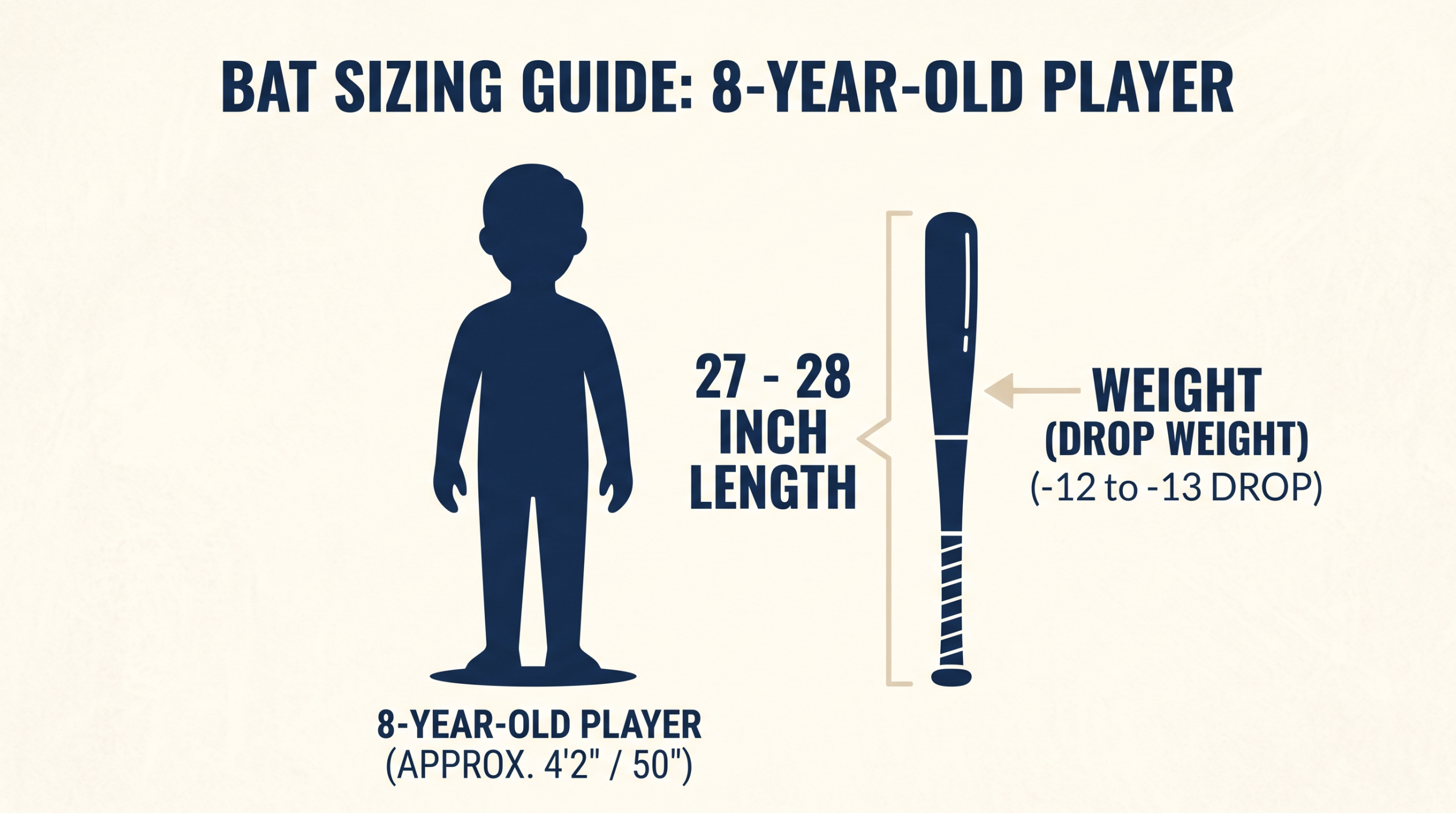
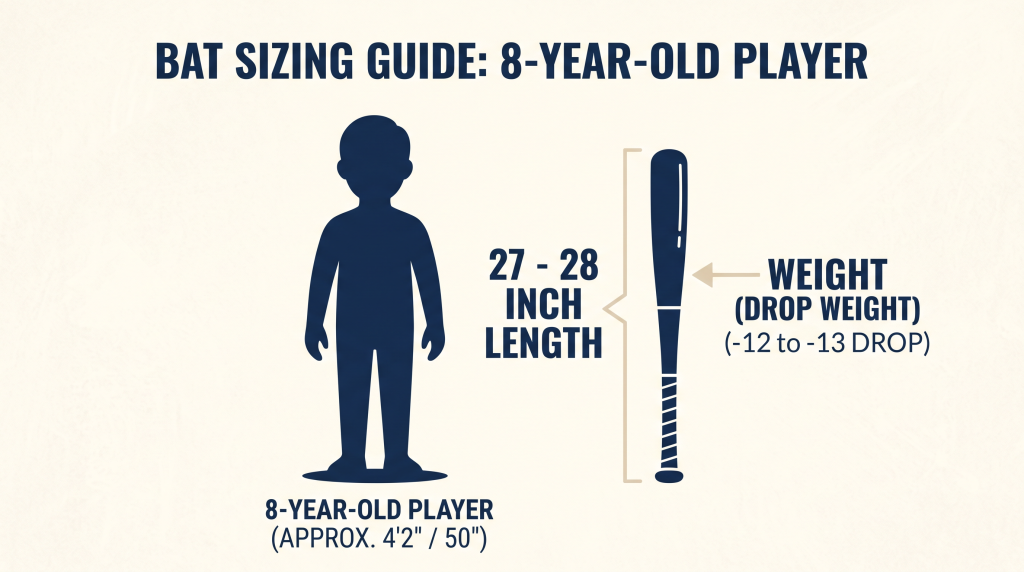
Most 8-year-olds do well with a 27-inch bat and a -12 drop, which puts the bat around 15 ounces. Light enough to swing freely, long enough to cover the plate.
Kids this age vary in size, so here’s the range:
| Player Size | Bat Length | Drop Weight | Est. Bat Weight |
|---|---|---|---|
| Smaller / lighter | 26″ | -12 | 14 oz |
| Average | 27″ | -11 or -12 | 15–16 oz |
| Taller / stronger | 28″ | -11 | 17 oz |
Use the bat size calculator for a recommendation based on your child’s actual height and weight.
At This Age, It’s All About Comfort
When a kid is eight and just starting out, the whole decision comes down to one thing: can they hold the bat comfortably and swing it without a struggle?
That’s it. That’s the bottom line. It’s not the brand. It’s not what the barrel is made of. It’s not whether it’s the lightest or most expensive composite on the rack. None of that stuff matters yet. What matters is that the bat isn’t too heavy for them to control and isn’t so light that they’re whipping it around with no idea where the barrel is going.
You’ll see both mistakes at the field. Some parents buy a bat with a barrel so heavy the kid can barely lift it. Others go too light, and the kid swings so fast and loose that there’s no control at all. Neither helps. The right bat sits in the middle, light enough to swing freely, with enough substance that the kid can feel where the barrel is.
The fancy stuff, durability, materials, how well a bat holds up in the rain and the cold, that matters when kids get older, bigger, and more serious. On travel teams. Getting ready for the next level. At eight, you’re not there yet, and you don’t need to pay for it.
The Mistake Almost Every Parent Makes
They overspend. And they do it for a good reason: they think buying the best equipment gets the best results. It doesn’t work that way.
Your kid is not going to hit a home run because you bought an expensive bat. I know that’s every parent’s dream. But you have to be realistic. Hitting comes from technique, from practice, from reps off a tee, from developing hand-eye coordination. A $300 bat doesn’t give a kid any of that. It just gives you a lighter wallet and a bat that’s going to get dinged up anyway.
Because here’s the other thing nobody tells you: these bats are not indestructible. Kids bang them around. They get chips, dents, dead spots. An 8-year-old is not thinking about protecting a $300 investment, they’re eight. So before you spend big, ask yourself an honest question that almost nobody talks about: does your kid actually take care of their equipment? If the answer is no, that’s even more reason to keep it affordable at this age.
Don’t Forget the Grip
One practical thing that gets overlooked. When you’re picking a bat for an 8-year-old, pay attention to the grip.
A bat with a poor, slick grip is a real problem for a little kid. They take a swing, the bat slips, and it goes flying across the field or into the dugout. Not safe, and not fun for anyone. A good grip on the bat helps. So does a decent pair of batting gloves, they give a young kid a much more secure hold and take a lot of the slip out of the equation. It’s a small thing, but it makes a difference at this age.
How to Check the Fit
The Arm-Extension Test
Have your child grip the bat handle and hold it straight out to the side at shoulder height, arm fully extended, bat parallel to the ground. If they hold it steady for 20 to 30 seconds without the arm dropping, the weight is right. If the arm drops right away, the bat is too heavy.
The Comfort Test
Watch how they hold it. The grip should feel natural, not like they’re squeezing for dear life. A relaxed hold gives a better swing. If an 8-year-old is straining just to keep the bat up, it’s too much bat.
The Ground Test
Stand the bat on the ground next to your child’s leg. The barrel should reach around the hip. If it barely clears the knee, it’s too short. If it reaches the belly button or higher, it’s too long.
What League Are They Playing In?
Most 8-year-olds play in USA Baseball leagues, Little League, Cal Ripken, and similar rec programs. These require a bat with the USA Baseball stamp on it. If you buy a bat without that stamp, it can’t be used in the game.
Some 8-year-olds in competitive travel programs use USSSA bats, which carry a different stamp (the 1.15 BPF thumbprint). The two are not interchangeable.
At eight, the odds are you need a USA Baseball bat. But ask the coach before you buy, it takes one question and saves you a return trip.
→ Full comparison: USA vs USSSA bats
Recommended Bat Sizes for 8-Year-Olds
Smaller or Lighter Players (under 50 lbs, under 4’0″)
26 inches, -12 drop (14 oz)
A smaller 8-year-old needs a bat they can actually control. Fourteen ounces at 26 inches is easy to swing and easy to handle. Don’t push a bigger bat on a kid this size, it’ll just wreck their swing before they’ve even developed one.
Average Players (50–60 lbs, 4’1″–4’4″)
27 inches, -11 or -12 drop (15–16 oz)
The standard starting point for a typical 8-year-old. A 27-inch bat at -12 is 15 ounces, which most kids this age can swing comfortably. This is the safe, sensible default.
Taller or Stronger Players (60+ lbs, 4’5″ and above)
28 inches, -11 drop (17 oz)
A bigger 8-year-old can handle a little more bat. Just make sure they pass the arm-extension test with it. If the arm drops, go back down to 27 inches. At this age, lighter is almost always the safer bet.
Frequently Asked Questions
Do I really need to spend more than $75 on a bat for an 8-year-old?
No. At this age, an affordable bat in the right size does everything you need. Spend your money on reps, a tee for the backyard, and letting your kid have fun. The expensive bats are for older, more serious players.
My 8-year-old wants a big barrel like the older kids. Should I get it?
A heavier, bigger-barrel bat usually just slows a young kid down and hurts their swing. What looks cool on the rack doesn’t help at the plate. Get the size that fits and let the barrel talk come later.
Should I get batting gloves for an 8-year-old?
They help more than you’d think. A good pair of batting gloves gives a young kid a more secure grip, which means better control and less chance of the bat slipping out of their hands mid-swing. Worth the small cost.”
How long will a 27-inch bat last my 8-year-old?
Kids grow fast at this age. A bat that fits at eight might be too short by the time they’re nine or ten. Don’t overbuy, trying to leave room to grow; get the right size now and move up when they actually need it. When figuring out bat size for 8-year-old, most kids this age do well with a 27- to 28-inch bat and a -12 or -13 drop
Use the bat size calculator to get a recommendation based on your child’s age, height, weight, skill level, and league. But at eight years old, don’t overthink it, get a bat that fits, make sure it’s legal for the league, and let them have fun.